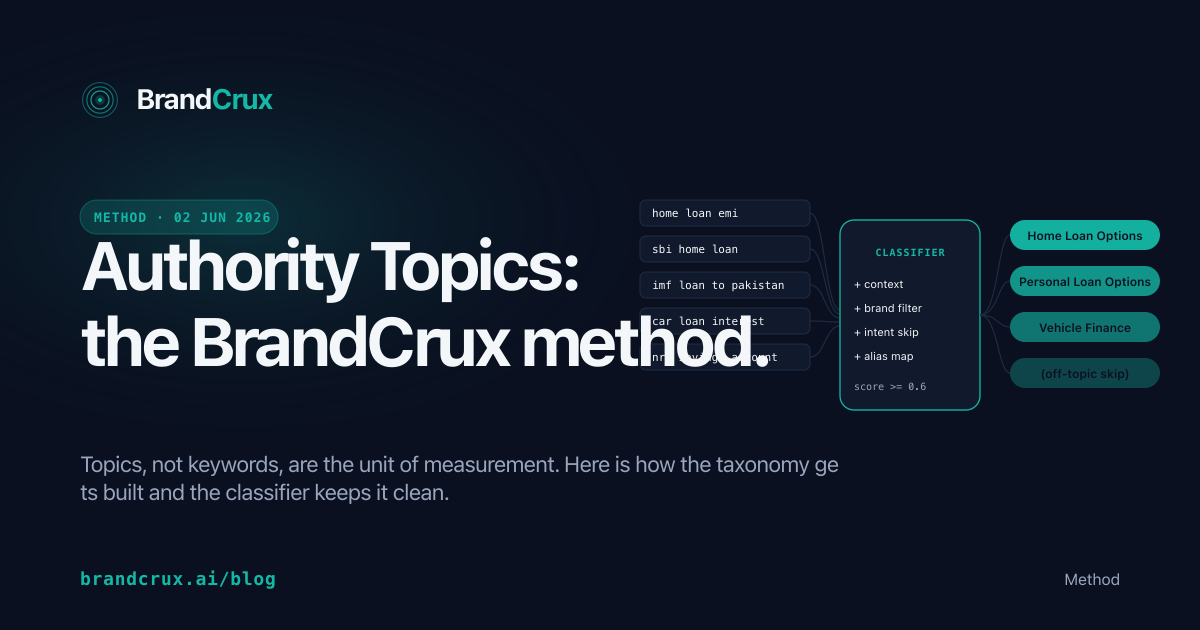
A keyword is "axis bank home loan interest rate". A topic is "Home Loan Options". The keyword is one query a customer types. The topic is the bundle of intent the brand is trying to own. Tracking keywords without rolling them up into topics is how brands end up ranking number one for 200 random phrases and still losing share on the three questions that drive the actual business.
We made topics the unit of measurement inside BrandCrux for that reason. Every signal we capture (AI mentions, SERP placements, citation density, social engagement, on-topic content depth, GEO readiness, and your own analytics) rolls up to a per-topic score. One number per topic. One verdict per topic. The keywords sit underneath.
What counts as a topic
A topic is a coherent product or category claim a brand can plausibly own. For Axis Bank: Home Loan Options is a topic. Personal Loan Solutions is another. NRI Banking Solutions is another. For Marketcheck Cars Inc: VIN Decoder Services, Used Car Valuation Tools, Vehicle Data APIs. For Mrudul Hearing Aid Centre: Custom & Invisible Hearing Aids, Tinnitus Management, Pediatric Hearing Aids.
Each of those phrases sits at the right altitude. Granular enough to drive specific content and outreach. Broad enough that fifty different keywords ladder up into it.
Where the topics come from
The first taxonomy is proposed by an LLM that has read your domain and your competitors. We crawl your homepage and top product pages, do the same for every competitor you track, and ask the model to surface coherent topical clusters that show up across the landscape. The output is eight to fifteen candidate topics with a description for each. You accept, edit, or replace them in onboarding.
We then keep refining. After every keyword discovery scan and SERP scan, the recommender re-reads the universe of terms the brand could plausibly compete on and proposes adjustments. Missing topics, redundant topics, topics with almost zero coverage. The user reviews; nothing is auto applied. This is the same flow the dashboard's "Suggested topics" strip surfaces.
The classifier that keeps topics clean
A topic is only useful if the keywords inside it actually fit. Our previous classifier got this wrong in a way we had to fix: it would route any keyword containing the word "loan" to whatever loan-shaped topic the workspace had. That is how we discovered IndusInd Bank's "Vehicle Finance Solutions" topic had absorbed queries like "imf loan to pakistan" and "india finance ministers", geopolitical news that happens to share a token with the topic name.
The fix was to make classification context-aware. The classifier now takes the business name, the domain, the categories the workspace owner picked at onboarding, the country, the full topic taxonomy with descriptions, and one keyword at a time. It returns a topic only when the intent of the keyword matches the topic, with a confidence floor of 0.6. Anything below that is skipped, not force-routed.
We then layered a brand-name filter on top. Any keyword containing a tracked competitor brand as a whole word is dropped before it reaches the LLM. "sbi home loan" for an Axis Bank workspace is not a Home Loan keyword. It is navigation traffic to a different brand, and counting it would overstate authority. The exclusion only fires for true competitors, not suppliers or partners; that distinction is itself an LLM call which we run on every competitor row.
One score, seven signals
Once a topic owns its keywords, the per-topic composite score is built from seven measurements:
- AI Visibility on this topic. Presence rate across the prompts mapped to this topic, averaged across the engines we test.
- Web SERP placement. How many of your topic's keywords sit in the top ten on Google for the workspace's primary country.
- Authority Signals. Directory + publisher citations that mention your brand on this topic, in the last sixty days.
- Social Authority. On-topic posts and the engagement they earned across the social networks you connect.
- Web Content depth. How many on-topic pages we found when we crawled your site, against the leading competitor's count.
- GEO infrastructure. The site-wide GEO Audit score, weighted by topic when the audit has per-topic data.
- Owned Analytics. Topic-mapped GSC + GA4 signal when those connectors are wired. Off the cuff is fine; with the connectors, the score gets sharper.
Each measurement is normalised to 0-100. The composite is a priority-weighted average: a P3 topic counts four times a P0, so a brand that has declared one or two flagship topics gets a score that actually reflects what they care about. Priorities are settable per business in two clicks.
What the score buys you
Per topic, every other tracked competitor gets the same treatment. That gives you a leaderboard, not a number in a vacuum. Axis Bank's Home Loan Options topic against ICICI's against Kotak's. Marketcheck's VIN Decoder Services against Edmunds' against J.D. Power's. You see who is leading, who is competing, who is behind. The diff is actionable; the absolute value alone usually is not.
Each topic also gets one of four recommendations the engine generates automatically:
- Lead. You are ahead by ten points or more on the composite. Defend the moat. Cadence here is the lightest.
- Defend. You are within five points of a competitor. The Plays engine surfaces the specific page additions, citation outreach, and SERP keyword briefs that close the gap.
- Compete. You are behind but the topic is worth pursuing. The recommender drafts a 30-day plan and the credit estimate it would cost to execute.
- Exit. The signal is so low across the board that the credits you spend on this topic are better redirected. We say so directly.
How we keep it honest over time
Topics drift. A bank's core product mix shifts; a SaaS company's positioning changes; a vertical's buyer vocabulary moves. We re-classify the keyword universe on a weekly cron with a 7-day freshness gate on each row. The recommender re-proposes topic adjustments after every SERP scan when the universe of new high-volume terms warrants it. The user always reviews; nothing in the taxonomy moves without a human accepting the diff.
When a competitor turns out to be a supplier (a hearing-aid clinic that retails Phonak should not treat Phonak as a competitor for brand-filter purposes), the relationship classifier catches it. When a new authority topic emerges from the gap between your declared topics and the keyword universe (Gold Loan Options, Loan Calculators, Education Loans for an Indian bank that had not yet declared them), the recommender surfaces it as a pending suggestion with its coverage volume attached.
The discipline behind the score
The reason Authority Topics is the unit of measurement inside BrandCrux is the same reason finance teams report gross margin and not just revenue: one well-defined number tells you whether the work was worth it. Every other view in the product, from the dashboard composite to the per-channel leaderboards to the weekly digest email, is built off the topic table.
The discipline is in the classifier: only the right keywords roll up; only the right competitors gate the brand filter; only signals strong enough to clear the confidence floor count. The dashboard gives you a number you can defend. The work underneath is what makes it one you should.